Towel Rail Dual Fuel Kit | Convert CH Rail to Electric
14 years supplying UK bathrooms, est. February 2012. Free delivery on orders over £200. 5-year manufacturer's warranty on all towel rails.
Dual Fuel Kits — Add Electric to Your Existing Central Heating Towel Rail
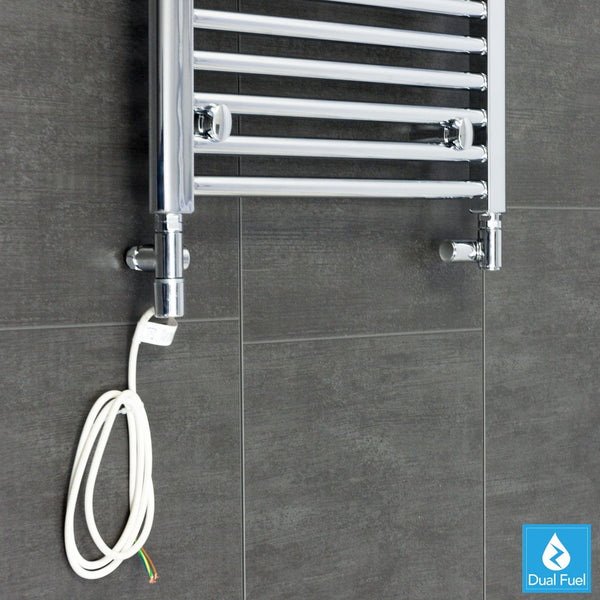
A dual fuel kit converts a standard central heating towel rail into a dual fuel model — one that runs on your boiler in winter and switches to an independent electric element in summer, without touching the pipework and without running the boiler just to warm towels. If you already have a CH towel rail installed and want that flexibility, this is the page you need. If you are buying a new rail and want dual fuel from the outset, see our complete dual fuel towel rail range.
Six products cover the main configurations: standard elements, thermostatic elements, WiFi elements, corner valve kits, T-piece adaptors, and the ER-Touch system. All are designed to fit standard ladder-style towel rails with a ½″ BSP bottom inlet.
How a Dual Fuel Kit Works
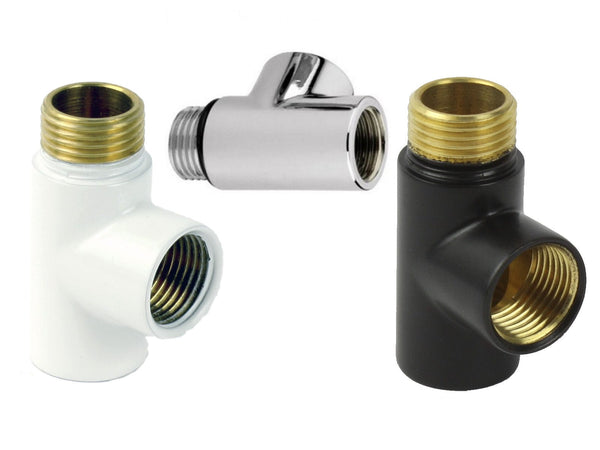
A standard central heating towel rail has two inlets at the bottom — one for flow, one for return. In a dual fuel conversion, one inlet takes a T-piece adaptor that accepts the electric heating element. The other inlet remains connected to your CH pipework as normal. When you want to run on electric, close the CH valve on the flow side to isolate the boiler circuit, and the element heats the water inside the rail independently. When you want CH, open the valve and switch off the element.
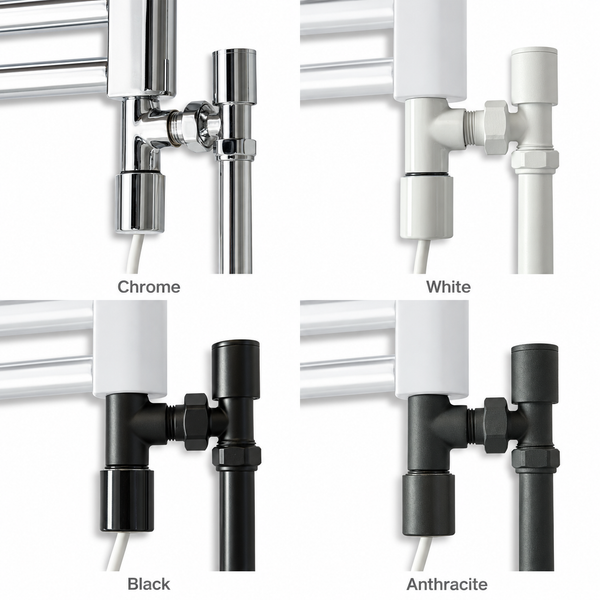
Three components are involved: the heating element (which screws into the T-piece), the T-piece adaptor (which connects the element to your existing pipework), and a blanking plug (which seals the unused inlet). Some kits include all three; some are sold individually if you already have part of the setup.
Which Element Type Do You Need?
Standard element: switched on and off manually at a fused spur or wall switch. The simplest and most affordable option. No programming — you control it directly. Suited to bathrooms where you remember to switch the rail on ahead of use.
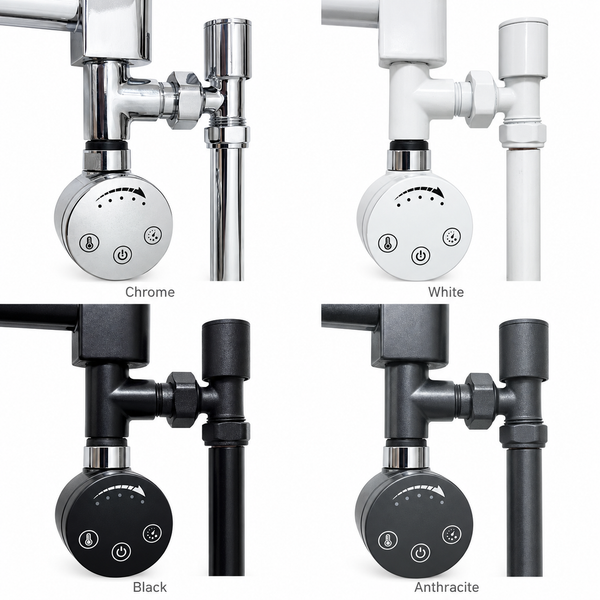
Thermostatic element: built-in thermostat maintains a set temperature automatically. Once switched on, it cycles on and off to hold the rail at your chosen warmth without overheating. More energy efficient than a standard element for bathrooms where the rail is left on for extended periods.
WiFi element: app-controlled from your phone. Set schedules, adjust temperature remotely, or switch on from outside the house before you arrive. The most convenient option for households with variable routines.
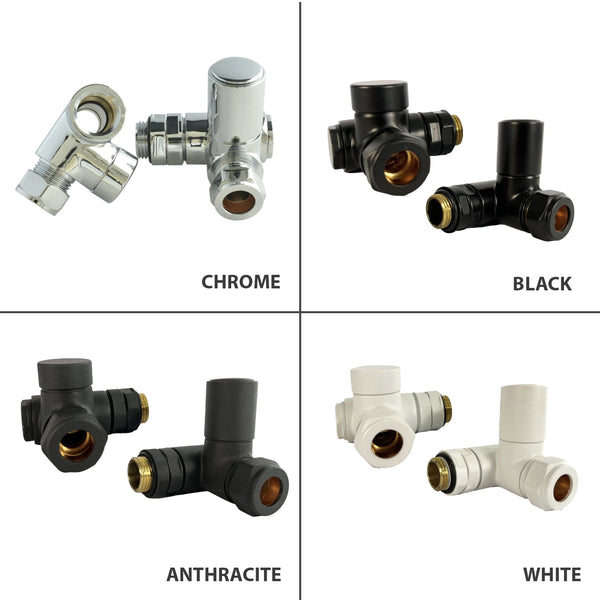
Corner valve kit: an alternative installation method where the element connects via a corner valve rather than a T-piece — suited to specific pipework configurations where a T-piece adaptor will not fit neatly.
Installation — What to Know Before You Buy
The electric element must always be installed at the bottom of the towel rail. Heat rises through the rail from the element at the base — fitting it at the top or mid-point results in uneven heating and poor performance. Most ladder-style towel rails have two bottom inlets, making the conversion straightforward.
Connecting the T-piece and element to the pipework is a plumbing task — isolate the CH circuit and drain the rail before starting. Hardwiring the element to a fused spur requires a qualified electrician. If the element is plug-in type, a standard 13A socket outside the bathroom zones is sufficient — check IP zone regulations for your specific bathroom layout before deciding between hardwired and plug-in.
For replacement elements without the adaptor hardware, see our towel rail heating elements range.
Frequently Asked Questions
Will a dual fuel kit fit any central heating towel rail?
Most standard ladder-style towel rails with ½″ BSP bottom inlets are compatible. Rails with side inlets or non-standard connection sizes may require a different adaptor configuration. Check your rail's inlet size and position before ordering — bottom inlet rails with ½″ BSP threads are the standard and suit all kits in this collection.
Do I need to drain the towel rail to fit a dual fuel kit?
Yes. To fit the T-piece adaptor, you need to isolate the towel rail from the central heating circuit and drain the water from it first. This involves closing the radiator valves, catching any water in a towel or tray as you disconnect the bottom inlet, fitting the T-piece, then reconnecting and bleeding the rail before reopening the valves.
Where does the element go in the towel rail?
The element must go at the bottom of the towel rail, screwed into the T-piece adaptor at one of the lower inlets. Heat rises from the element and circulates upward through the rail. Fitting the element at the top or mid-point will result in the lower bars staying cold and the upper bars overheating — always bottom-mount.
Can I switch between central heating and electric myself?
Yes — switching between modes is simple and requires no tools. To run on electric: close the CH valve on the flow side to isolate the boiler circuit, then switch on the element at the fused spur or wall switch. To switch back to central heating: turn off the element, open the CH valve, and the rail reintegrates into the heating circuit as normal.
Do I need an electrician to fit a dual fuel element?
If the element is hardwired to a fused spur, yes — a qualified electrician must make that connection. Hardwired elements are the most common choice in bathrooms where there is no accessible socket. If your element is plug-in type, a standard 13A socket located outside the bathroom IP zones is sufficient and no electrician is required for the connection itself. Always confirm IP zone compliance for your specific installation before choosing plug-in or hardwired.